
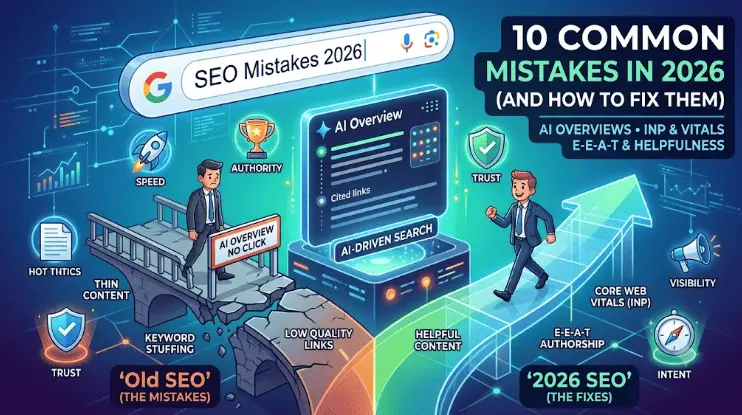
Search engine optimization is still the cornerstone of online visibility; roughly two-thirds of online experiences begin with a search engine, according to long-running BrightEdge tracking. But 2026 is not the SEO landscape that statistic implies. AI Overviews now appear across a large and growing share of Google results, a majority of searches end without a click to any website, and Google has folded “helpfulness” and E-E-A-T (Experience, Expertise, Authoritativeness, Trustworthiness) directly into its core ranking systems rather than treating them as a separate checklist item.
That context matters, because most of the SEO mistakes that quietly sabotage businesses haven’t changed in nature; they’ve changed in consequence. Skipping technical SEO used to mean slower rankings; in 2026 it can mean failing the Core Web Vitals threshold entirely. Chasing keyword density used to be merely pointless; it now actively fights against how Google evaluates natural, topically complete writing. And ignoring AI-driven search results isn’t optional anymore; it’s a visibility channel with its own rules.
This guide walks through ten of the most damaging SEO mistakes businesses still make, what the current data says about each one, and the fixes that hold up in 2026, plus a bonus section on the one mistake most SEO guides still don’t mention.
Table of Contents
Understanding the SEO Foundation in 2026
Effective SEO still rests on three pillars: technical health, content quality, and user experience, but Google has been explicit that a fourth factor now sits underneath all three: demonstrated helpfulness. Since the helpful content system was folded into Google’s core ranking systems, every page is evaluated on whether it was built to satisfy a searcher or to game a ranking system, and that evaluation gets re-weighted with every core update (Google confirmed five broad core updates between February and June 2026 alone).
Google’s own guidance on how Search works and its E-E-A-T documentation both point the same direction: content should demonstrate real expertise and serve the reader first. Reporting on the March 2026 core update quoted SEO analysts noting that clear authorship, accurate sourcing, and full topic coverage carry more weight precisely because they help Google judge which pages are reliable enough to rank consistently, not because Google introduced a new rule, but because it changed how heavily existing signals are weighted.
The Foundational SEO Mistakes
Mistake #1: Ignoring Keyword Research and Search Intent
The Problem
Many businesses still publish content without understanding what their audience actually searches for, or they chase high-volume keywords without checking the intent behind them. That mismatch is more costly in 2026 than it used to be: Google’s systems have gotten materially better at separating pages that technically match a query from pages that genuinely satisfy it, and a page can have the keyword in the title, solid metadata, and clean headings, yet still lose to a page that better matches what the searcher actually wanted.
Why It Happens
Businesses often base keyword choices on internal language or industry jargon rather than researched customer search behavior, and many skip research entirely because it feels technical or time-consuming.
The Fix
Use keyword research tools such as SEMrush, Ahrefs, or Google Keyword Planner, but weight intent over volume. Since AI Overviews now resolve a large share of purely informational queries directly on the results page, it’s worth prioritizing keywords with clear commercial or transactional intent, comparison, pricing, “best X for Y”, and local queries, where a click to your site is still the likely outcome, alongside a smaller set of authoritative informational content that builds topical credibility.
- Primary keywords for your main topics
- Long-tail keywords for specific queries
- Semantic and entity keywords that support your main themes
- Local keywords if you serve specific geographic areas
Measuring Success
Track organic traffic and query-level performance in Google Search Console, but in 2026 also track impressions separately from clicks; impression growth with flat clicks can indicate you’re being surfaced in an AI Overview without a citation, which is a different problem than a ranking problem.
Mistake #2: Neglecting Technical SEO Fundamentals
The Problem
Technical SEO, crawlability, indexability, site architecture, and performance remain the foundation search engines need in order to find and rank content at all. Businesses that focus only on content while ignoring broken internal linking, missing XML sitemaps, misconfigured robots.txt files, or slow page speed undermine everything else they do.
What Changed
Core Web Vitals themselves changed in March 2024: Google retired First Input Delay (FID) and replaced it with Interaction to Next Paint (INP) as the official responsiveness metric. INP measures every interaction across a page’s full lifecycle rather than just the first one, and it’s a stricter bar, current Chrome User Experience Report tracking puts roughly 43% of websites still failing the 200-millisecond “good” INP threshold in 2026, even as overall Core Web Vitals pass rates have climbed to around 55% of web origins passing all three metrics (LCP, INP, and CLS) as of early 2026.
The Fix
Run a comprehensive audit using Screaming Frog, Google Search Console, or SEMrush, and treat these as non-negotiable:
Site Structure and Crawlability
- Build a clear URL structure and logical internal linking.
- Keep important pages within three clicks of the homepage.
- Submit updated XML sitemaps and configure robots.txt correctly.
- Fix broken links and implement canonical URLs to avoid duplicate-content issues.
Core Web Vitals
- Largest Contentful Paint (LCP): aim under 2.5 seconds.
- Interaction to Next Paint (INP): aim under 200 milliseconds; heavy JavaScript and analytics tags are the most common cause of failure.
- Cumulative Layout Shift (CLS): aim under 0.1 by reserving space for images, embeds, and ads.
Success Metrics
Google grades Core Web Vitals as field data from real Chrome users (the CrUX report) at the 75th percentile over a rolling 28-day window; a perfect score in your own dev tools means little if a quarter of real visitors on mid-range phones have a slow experience. Track this in Search Console alongside crawl stats and index coverage.
Mistake #3: Poor On-Page Optimization
The Problem
On-page elements- title tags, meta descriptions, header structure, alt text, and schema markup- directly tell search engines (and increasingly, AI systems) what a page is about. Missing or generic versions of any of these leave even strong content struggling to reach its ranking potential.
The Fix
- Title tags: unique, under ~60 characters, primary keyword included naturally.
- Meta descriptions: unique, around 155 characters, with a clear value proposition.
- Header structure: one H1 with the primary keyword and clear purpose; H2s and H3s to build a logical hierarchy.
- Image alt text: descriptive and keyword-relevant, for accessibility as much as SEO.
- Schema markup: worth prioritizing in 2026 specifically because structured data helps both rich-result eligibility and AI systems parse and cite your content accurately; one widely cited industry estimate puts the CTR lift from structured data at up to 40% (BlueTone Media), though results vary by schema type and query. Roughly 31% of websites still use no structured data at all (Smart Metrics Agency), which is a meaningful gap to close relative to competitors.
Measuring Results
Track average position and click-through rate in Search Console, and monitor bounce rate and dwell time as engagement signals.
Content Strategy SEO Mistakes
Mistake #4: Creating Content Without an SEO Strategy, or Without Real Expertise
The Problem
Content and SEO still get treated as separate workstreams at many businesses. Writers create valuable material without researching what the audience searches for, using internal jargon that doesn’t match real queries, so the content never gets found.
What Changed
This mistake has gotten more expensive since 2024. Google’s helpful content system is now a permanent, site-wide part of core ranking, not a standalone filter, which means a pattern of thin or generic pages can drag down a site’s best content, not just the weak pages themselves. Reporting on the 2026 core updates has repeatedly linked stronger, more resilient rankings to pages with clear authorship, credible sourcing, and full topic coverage, the practical expression of E-E-A-T. Separately, Ahrefs’ large-scale ranking analysis found the average top-10 page is over two years old, and only about 6% of newly published pages reach the top 10 within a year, a reminder that content needs a maintenance plan, not just a publish date.
The Fix
Content gap analysis: find topics your audience searches for that your industry hasn’t covered well.
Topic clusters: build pillar pages with supporting long-tail content to establish topical authority.
E-E-A-T in practice: real author bios and credentials, cited sources, and the part most content skips: an actual first-hand example, case study, or number from your own work. This is the single highest-leverage fix available, and the one AI-generated content structurally can’t provide on its own.
Success Measurement
Track organic traffic growth, search visibility, and conversion rate by content piece, and double down on the topics and formats already converting.
Mistake #5: Keyword Stuffing and Over-Optimization
The Problem
Businesses know they need keywords in their content, but many overdo it, producing repetitive text that reads unnaturally and provides a poor user experience. Modern search systems detect this easily.
The Data That Settles This
Google has stated for well over a decade, as far back as a 2011 Matt Cutts explainer, that no keyword-density percentage improves rankings, and Google’s current Search Advocate John Mueller has repeated the same answer (“no”) whenever it resurfaces. An independent analysis of over 1,500 search results found no consistent correlation between keyword density and ranking at all; top-10 results averaged roughly 0.04% keyword density, far below the 2–3% figures still circulated in outdated SEO guides. If your current content strategy targets a density percentage, that’s worth retiring.
The Fix
Write for readers first. Use synonyms, related terms, and natural language; modern semantic search matches meaning, not exact strings.
Cover the topic thoroughly. Comprehensive, well-organized coverage of a subject naturally produces the right vocabulary without engineering it.
Tracking
Watch bounce rate, time on page, and conversion rate; naturally written, thorough content consistently outperforms keyword-stuffed alternatives on every one of these.
Mistake #6: Ignoring Local SEO (for Local Businesses)
The Problem
For location-based businesses, skipping local SEO forgoes one of the highest-intent traffic sources available. An estimated 46% of all Google searches carry local intent, and roughly 76% of people who make a “near me” style search visit a business within 24 hours (Google-referenced data via multiple 2026 industry trackers). Common local SEO failures include an incomplete Google Business Profile, inconsistent NAP (Name, Address, Phone) information across directories, and no geo-targeted keyword strategy.
The Fix
- Google Business Profile: complete it fully, keep it updated, and actively manage reviews; businesses with complete profiles report more location visits than those with incomplete ones.
- Citation consistency: keep NAP information identical across every directory and citation source.
- Location-based content: address local customer needs, nearby landmarks, and community context.
- Local link building: relationships with local organizations and community sites strengthen local authority signals.
Results Measurement
Track Google Maps rankings, local pack visibility, and, since a growing share of local queries now trigger an AI Overview or AI-driven local recommendation, direct actions (calls, direction requests, booking clicks) rather than website sessions alone.
Link Building and Authority SEO Mistakes
Mistake #7: Neglecting Internal Linking Strategy
The Problem
Many businesses focus heavily on external backlinks while ignoring the SEO value of strategic internal links. A weak internal link structure makes it harder for search engines to understand site hierarchy and distribute authority, and it wastes a chance to guide users toward relevant content.
Best Practices
- Use descriptive anchor text with target keywords; avoid generic phrases like “click here.”
- Build pillar pages that link out to detailed supporting articles, reinforcing topical authority.
- Map the user journey and place links that guide readers toward relevant next steps.
- Distribute links across multiple pages rather than concentrating everything on the homepage.
Measuring Success
Monitor pages-per-session and user flow in Google Analytics, and track which internal links drive the most clicks toward conversions.
Mistake #8: A Poor, Toxic, or Policy-Risking Backlink Profile
The Problem
Not every backlink helps; some actively hurt rankings. Businesses that either neglect link building entirely or chase low-quality links from spammy sites, link farms, or irrelevant sources risk both weaker authority and direct search engine penalties.
What Changed: Site Reputation Abuse
This is the area that’s shifted most since 2024. Google’s spam policies now explicitly define “site reputation abuse”: publishing third-party content on a site mainly because that host site’s existing ranking signals will help the content rank, rather than because it genuinely serves the host’s audience. This directly targets scaled, low-editorial-oversight guest posting and “rent-an-authority” link placements, practices that used to be a standard, low-risk link-building tactic. Google has been explicit that guest posting itself isn’t a violation; the risk is scale without editorial standards, sites that accept nearly any submission, templated posts built mainly to carry commercial anchors, or content with no real fit for the host’s audience.
The Fix
- Audit your backlink profile with Ahrefs, Moz, or SEMrush for low-authority, irrelevant, or spammy sources.
- Favor genuine editorial fit for any guest posting or contributed content; the test is whether it would exist if it carried no link at all.
- Limit outbound links per placement and prefer descriptive or branded anchors over exact-match keyword anchors.
- Earn links through linkable original research, digital PR, and relationships with relevant publications rather than volume-based outreach.
- Use Google’s Disavow Tool only for links you can’t remove through outreach and that you’re confident are actively harmful.
Success Metrics
Track referring domain quality and relevance, not just raw backlink count, alongside referral traffic and organic performance as your profile strengthens.
Measurement and Strategy SEO Mistakes
Mistake #9: Not Tracking the Right SEO Metrics
The Problem
Many businesses track vanity metrics, raw rankings, or traffic volume, without connecting them to conversion rate or revenue. That gap is more dangerous in 2026 because a growing share of impressions never convert to a click at all; raw traffic can decline even when visibility and business impact are actually improving.
Essential KPIs for 2026
Traffic Quality
- Organic traffic and click-through rate from target keywords
- Bounce rate and dwell time for organic visitors
- Impressions relative to clicks in Search Console; a widening gap can signal AI Overview exposure without a citation.
Conversion-Focused
- Conversion rate and lead generation from organic traffic
- Revenue attributed to organic search
Technical Performance
- Core Web Vitals (LCP, INP, CLS)
- Mobile usability and crawl error frequency
Visibility Beyond the Click
- Share of voice and keyword gap analysis versus competitors
- Whether your brand is cited inside AI Overviews for relevant queries, tools that track AI Overview presence and citations are becoming as important as traditional rank trackers.
Analytics Setup
Combine Google Analytics 4 and Search Console with goal tracking that ties SEO work to business outcomes, not just rankings.
Mistake #10: Expecting Immediate Results and Giving Up Too Soon
The Problem
Businesses frequently expect SEO to behave like paid advertising, fast, linear, and immediately measurable, and abandon working strategies before they’ve had time to show results.
What Google Actually Says
Former Google spokesperson Maile Ohye has stated that most SEO efforts need four months to a year before meaningful benefit appears, and current Search Advocate John Mueller has put full impact at roughly six months to a year for most sites, longer for brand-new domains, which he’s said can take up to a year just for Google to determine where they belong in rankings. This isn’t Google being deliberately slow: trust and relevance signals need real time and real user behavior to accumulate.
A Realistic Timeline
Months 1–3: Foundation
- Technical SEO fixes typically show the fastest movement.
- On-page optimization begins affecting rankings.
- Content strategy implementation starts.
Months 3–6: Momentum
- Content marketing gains traction.
- Link-building relationships develop.
- Local SEO improvements become visible.
Months 6–12 and Beyond
- Meaningful organic traffic growth and brand authority.
- Sustained, compounding long-term growth for sites that keep investing.
Maintaining Long-Term Success
Google runs multiple core and spam algorithm updates every year, and content that ranked well in 2024 can lose ground by 2026 simply because competitors published better, more current material, not because anything about your page changed. Regular content refreshes and ongoing audits are part of maintaining rankings, not a one-time project.
The SEO Mistake Most Guides Still Miss
Bonus Mistake: Ignoring AI Overviews and the Zero-Click Reality
The Problem
Search in 2026 doesn’t look like search in 2022. AI Overviews now appear on a substantial and growing share of Google queries, estimates range roughly from a quarter to just under half of tracked queries depending on the study and query type, and independent trackers put the overall zero-click rate (searches that end without any website click) anywhere from roughly 60% to nearly 70% of all Google searches, climbing meaningfully higher, into the 80s%, specifically on queries where an AI Overview is shown.
Businesses that still measure SEO success purely by click volume are increasingly measuring a shrinking part of the picture. Multiple independent studies through 2025 and 2026, including large-scale analyses from Ahrefs and Seer Interactive, found organic click-through rates commonly drop by 30–60% or more on informational queries once an AI Overview appears above the results. The effect is uneven: brands and publishers cited inside an AI Overview tend to see a meaningful click lift compared to competitors who aren’t cited, while sites that were previously winning purely on informational content have seen some of the sharpest declines.
Why This Happens
Most businesses are still optimizing purely for the traditional “ten blue links” results page and have no strategy for being extracted, summarized, and cited by AI systems, which pull from structured, clearly attributed, well-organized content more readily than from dense or ambiguous prose.
The Fix
- Structure content for extractability: clear, direct answers near the top, defined terms, and well-labeled lists; the same structure that helps human skimmers helps AI systems lift accurate summaries.
- Use schema markup consistently so both traditional rich results and AI systems can parse your content’s structure and authorship correctly.
- Build genuinely citation-worthy authority; original data, first-hand case studies, and expert commentary are harder for AI systems (and competitors) to reproduce than generic advice.
- Track AI Overview presence and citation rate for your target queries alongside traditional rankings; several SEO platforms now offer this as a distinct metric.
- Redefine ‘success’ to include impressions and share of voice, not clicks alone, particularly for high-volume informational queries you know will increasingly resolve on the results page itself.
The Balanced View
This shift is real, but it isn’t a uniform collapse. Search demand itself hasn’t disappeared; it’s being redistributed, with the biggest declines concentrated in purely informational content that AI Overviews answer directly, and comparatively smaller effects on transactional, local, and highly specific queries where a click to an actual website remains the likely outcome. Treat this as a strategic shift in where and how visibility pays off, not a reason to abandon SEO.
Action Plan and Next Steps
Quick Wins for Immediate Impact
- Audit your current state: use Google Search Console to identify technical issues and quick opportunities.
- Optimize your highest-traffic pages first; they already have search equity to build on.
- Fix critical technical issues: broken links, crawl errors, and Core Web Vitals failures, especially INP.
- Refresh your most important existing pages with current information and clearer structure rather than only publishing new content.
Month 1 Priorities
- Complete a comprehensive SEO audit.
- Fix critical technical SEO issues, prioritizing INP failures.
- Optimize your Google Business Profile (for local businesses).
- Set up analytics tracking that separates impressions from clicks.
Months 2–3 Focus
- Implement content strategy improvements, including at least one genuinely first-hand example or data point per key page.
- Begin strategic internal linking and quality-first outreach for backlinks.
- Review any existing guest-posting or link-building program against Google’s site reputation abuse guidance.
- Run competitive and keyword-gap analysis regularly.
When to Consider Professional Help
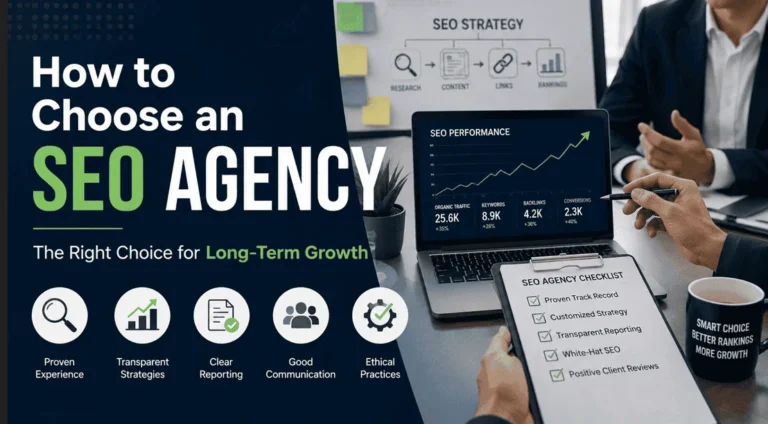
Consider hiring an SEO consultant or choosing an SEO agency if you lack internal technical expertise, need faster results in a competitive market, want your team focused on core business activities, or need a comprehensive strategy built from the ground up.
Conclusion
SEO success in 2026 isn’t about perfection; it’s about consistent improvement and avoiding the mistakes that quietly undermine an otherwise solid strategy. The fundamentals (technical health, real keyword research, quality content, and a clean backlink profile) still matter as much as ever; what’s changed is the environment around them, from a stricter Core Web Vitals standard to an AI-driven results page that rewards genuine expertise and citation-worthy authority over generic, keyword-matched content.
Businesses that treat SEO as an ongoing investment, tracking the right metrics, adapting to core updates, and building content only they could have written, are the ones positioned for durable, compounding organic growth. Use this guide as a working checklist, revisit it as the data changes, and adjust based on your own results.
Frequently Asked Questions
- What Are the Most Common SEO Mistakes?
The most damaging and common SEO mistakes are: ignoring keyword research and search intent, neglecting technical SEO and Core Web Vitals, poor on-page optimization, creating content without a strategy or real expertise, keyword stuffing, ignoring local SEO, weak internal linking, a toxic or policy-risking backlink profile, tracking the wrong metrics, expecting immediate results, and, increasingly in 2026, ignoring AI Overviews and zero-click search entirely.
- What Are the Main Types of SEO?
On-Page SEO: optimizing individual pages, titles, meta descriptions, headers, content, and images to match search intent.
Technical SEO: ensuring a site is crawlable, indexable, fast, and passes Core Web Vitals.
Off-Page SEO: building domain authority through backlinks, digital PR, and brand mentions.
Local SEO: optimizing for location-based searches through Google Business Profile, citations, and geo-targeted content. - What Replaced First Input Delay in Core Web Vitals?
Interaction to Next Paint (INP) officially replaced First Input Delay (FID) as Google’s responsiveness metric in March 2024. INP measures every interaction across a page’s full lifecycle, not just the first one, making it a stricter and more representative measure of real-world responsiveness.
- Do AI Overviews Mean SEO Is Dead?
No, but they mean SEO success needs to be measured differently. AI Overviews and rising zero-click rates are reducing raw click volume on many informational queries, but transactional, local, and highly specific searches still reliably send clicks to websites, and brands cited inside AI Overviews tend to see a click lift rather than a loss. The practical shift is toward tracking impressions, share of voice, and AI citation alongside, not instead of, traditional rankings.
- How Long Does SEO Take to Show Results?
Google’s own guidance, from both former spokesperson Maile Ohye and current Search Advocate John Mueller, puts meaningful results at roughly four months to a year for most sites, with new domains sometimes taking up to a year before Google fully determines where they belong in rankings. Technical fixes tend to show the fastest movement; sustained authority and traffic growth take longer.